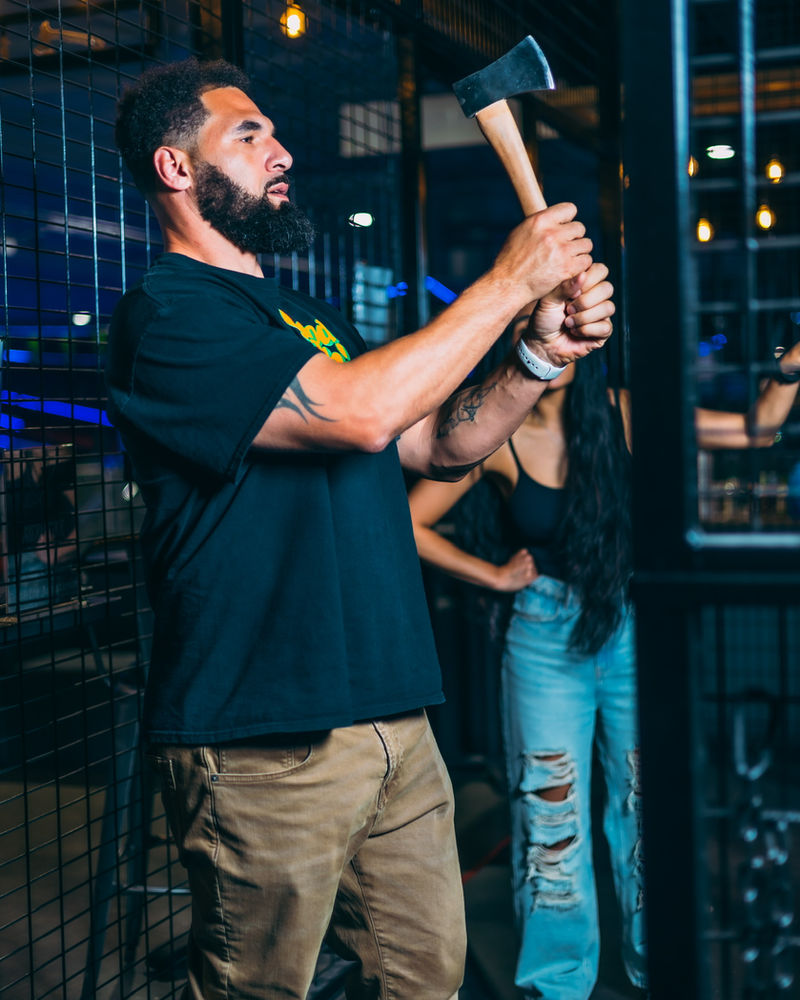
What check-in and the safety briefing actually look like
Check in, get oriented, and listen through the safety briefing before anyone throws. Staff sets up the lane, and the early pointers give your first throws a place to land.
Nobody expects you to arrive with experience. The job is simple: listen, take the first few throws slow, and find the rhythm.
What the first few throws feel like
The first throw can feel surprisingly deliberate: pick the target, settle your feet, and give the motion enough room to finish instead of trying to force it. A comfortable beginner starting point is a two-handed throw, with a balanced stance and an easy release. It’s less about strength than giving yourself a repeatable motion to learn from.
If an early throw lands somewhere unglamorous, welcome to the club. Make one small adjustment, take the next attempt, and notice what changed. Sticking a throw is satisfying because it comes after you figured something out.
Is axe throwing safe? Is it hard?
It’s reasonable to ask both. The safety briefing exists for a reason, and the first session gives you time to understand the lane before confidence outruns technique. You don’t need to be especially strong or already good at a target sport to enjoy it; you only need to pay attention, follow the briefing, and let the first few throws be practice.
A throw does not have to be perfect to feel good. One clean stick is usually all it takes to turn nerves into a rematch.
What counts as closed-toe shoes
This is the one outfit detail to settle before you leave home. Choose shoes that cover your toes and let you stand comfortably while you throw. Then you can spend the visit thinking about your release instead of your footwear.
How projected targets and automatic scoring change the round
The axe still meets real wood. What changes around it is the round: projected targets give the group something clear to chase, while automatic scoring keeps the result moving so nobody has to keep score by hand. That makes it easier for a first-timer to focus on the next throw.
Choosing the session that fits your first visit
A shorter session is a clean fit for a curious first try, a date-night add-on, or a group that wants to sample the experience before it turns competitive. A longer session gives everyone more room to settle in, trade attempts, and let the competition build.
The exact session options are in the first-visit facts above. When you are ready to choose one, the axe throwing page has the current session details and booking.
Is axe throwing good for dates, birthdays, or teams?
For a date, it is a shared “we have never done this before” story with a scoreboard nearby. For an older birthday group, where everyone throwing is 12 or up, it works even when skill levels do not match. For a team, it is an easy reset from the usual meeting-room atmosphere. Each fit has its own planning details, and for a birthday group the birthday parties page is the better next stop.
When you are ready, explore axe throwing at Nitro City. The first throw is allowed to be imperfect. By the third, you’ll have opinions about form.