You’re racing the clock, not the kart next to you
At Nitro City, races are scored by your single fastest lap. Racers call it your hot lap. The screen ranks every driver in the session by their best lap, not by who is physically in front on track.
That changes how you read the race. Passing someone doesn’t mean you’re beating them, and getting passed doesn’t mean you’re losing. The driver sliding by might still be half a second off your best lap. The only opponent that counts is the clock, and it gives you a fresh shot at it every single lap.
What the timing screen is telling you
A lap time is simple: how long it took you to get from the timing line all the way around and back to it. The screen doesn’t know whether a corner felt dramatic or whether your friends were watching, and that’s exactly what makes it honest.
Your fastest lap is the headline number. Keep it. Enjoy it. But one lucky quick lap doesn’t mean much until you can do it twice. Several laps landing close together is what you’re aiming for: it means you’ve found a line you can repeat, and repeatable is what fast drivers are built from.
Read the lap in three parts
- Entry: finish your braking before you turn the wheel. Rush the entry and the whole corner gets slow.
- Apex: turn once. If you’re sawing at the wheel mid-corner, you turned in too early or too fast.
- Exit: unwind the wheel and lay on the gas. Get the exit right and you carry that speed down the entire next straight.
Find the racing line
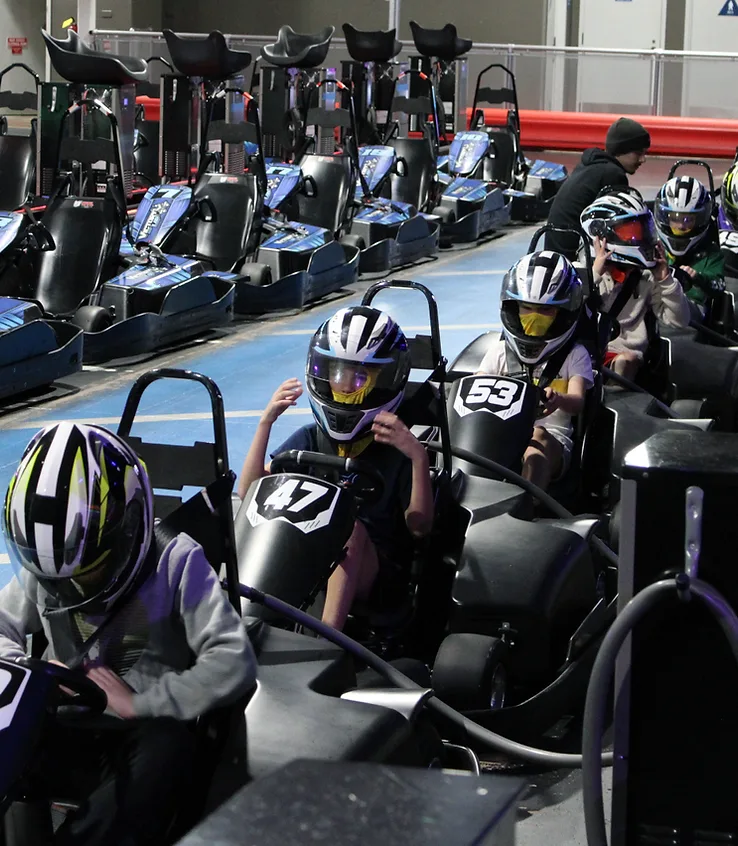
The racing line is the path that straightens the corner as much as possible. Enter from the outside edge, cut down to clip the inside at the middle of the turn (that’s the apex), then let the kart run back out to the outside edge as you leave. Wide in, tight at the apex, wide out.
Hugging the inside the whole way around feels smart because it’s the shortest distance, but the tight arc forces you to slow way down. The wider shape lets you carry more speed through the same corner. Watch the quickest drivers in your session and you’ll see it: they use the full width of the track, every lap.
Two habits make the line easier to hit. Look ahead to the apex before you arrive, then move your eyes to the corner exit as soon as you clip it. The kart goes where your eyes go.
Change one thing, then check the clock
Change one thing at a time: brake a little earlier, look farther through the corner, or unwind the wheel sooner. Then run a few laps without changing anything else, so you can actually tell whether it helped. Change everything at once and the timing screen can’t tell you what worked. It can only report that something happened.
Smooth is fast
Listen to the tires. A quick chirp on turn-in is fine. A long squeal while you slide the kart sideways through the corner can feel great, but that noise means the tires have lost their grip. A sliding kart is scrubbing off speed mid-turn, and it has nothing left for the launch onto the straight.
So keep the slides small: brake before you turn, steer once, and feed in the gas as the wheel straightens. If the lap sounds quiet, it’s probably quick.