You’re racing the clock, not the kart next to you
Every race at Nitro City is scored the same way: your single fastest lap. Racers call it your hot lap. The screen ranks every driver in the session by their best lap, so the order on track and the order on the screen are two different things.
That changes how you read a race. Passing someone doesn’t mean you’re beating them, and getting passed doesn’t mean you’re losing. Starting position is random, everyone gets the same seven minutes, and the only opponent that counts is the clock. It gives you a fresh shot at it every lap.
What the timing screen shows
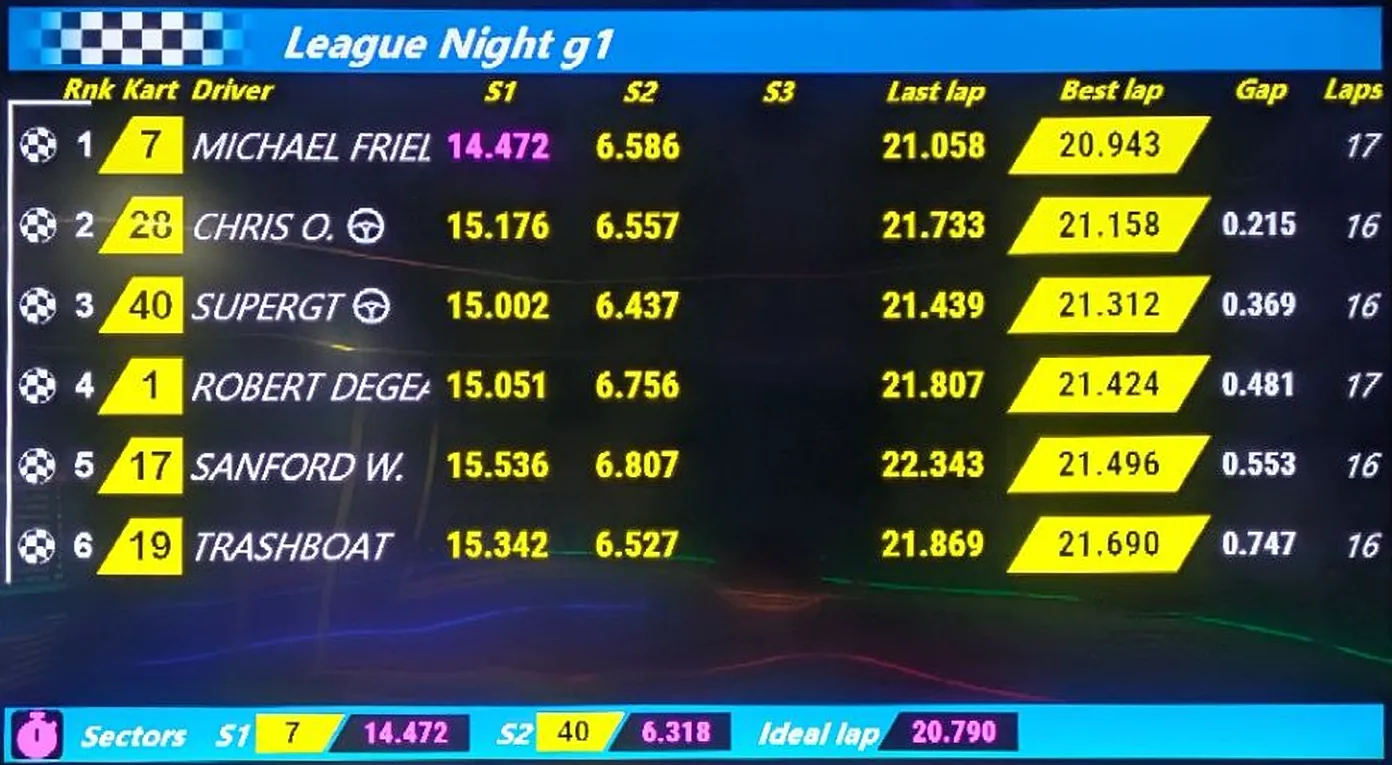
That’s a real results screen after a race at Nitro City. Your race ends on a screen like this one. Here’s what each column means:
- Rank: where your best lap stands against everyone else in the session. This is the finishing order.
- Kart: the number on the kart you drove.
- S1, S2, S3: sector times for the lap you just finished. The lap is split into sections and each one is timed on its own, so you can see which part of the lap is costing you.
- Last lap: the lap you just finished. Compare it with your best to see whether you’re getting quicker or sliding backwards.
- Best lap: your fastest single lap. This is the number that decides the race.
- Gap: how far your best lap is behind the leader’s, in seconds.
- Laps: how many laps you completed. More laps is not a higher score; it only means more chances at a quicker one.
The strip along the bottom shows the fastest time in each sector and which kart set it, plus the ideal lap: the time you’d get by putting the best sectors together in one lap. It’s usually quicker than anyone’s actual best lap, and the difference is the time still waiting to be found.
The screen doesn’t know whether a corner felt dramatic or whether your friends were watching, and that’s exactly what makes it honest. One lucky quick lap is nice. Several laps landing close together is better: it means you’ve found a line you can repeat, and repeatable is fast.
What “5 laps” or “10 laps” means
A lap is one full circuit from the start-finish line back to it. Ten laps means you crossed it ten times. At Nitro City you don’t buy laps, you buy races: a race is about seven minutes on track, timed laps after a warmup lap, and how many laps fit into those minutes depends on how quick you are. A high lap count is a side effect of a fast lap, not the goal.
What is a good lap time?
Honest answer: it depends on the track. A lap time only means something next to other laps on the same track, in the same layout, in the same kind of kart.
So judge your lap two ways. Against the best lap on your session’s screen, which is bragging rights. And against your own earlier laps, which is progress. The second one is the one I care about.
Read the lap in three parts
- Entry: finish slowing down before you turn the wheel. Rush the entry and the whole corner gets slow.
- Apex: turn once. If you’re sawing at the wheel mid-corner, you turned in too early or too fast.
- Exit: unwind the wheel and lay on the gas. Get the exit right and you carry that speed down the entire next straight.
Find the racing line

The racing line is the path that straightens the corner as much as possible. Enter from the outside edge, cut down to clip the inside at the middle of the turn (that’s the apex), then let the kart run back out to the outside edge as you leave. Wide in, tight at the apex, wide out.
Hugging the inside the whole way around feels smart because it’s the shortest distance, but the tight arc forces you to slow way down. The wider shape lets you carry more speed through the same corner. Watch the quickest drivers in your session and you’ll see it: they use the full width of the track, every lap.
Two habits make the line easier to hit. Look ahead to the apex before you arrive, then move your eyes to the corner exit as soon as you clip it. The kart goes where your eyes go.
Change one thing, then check the clock
Change one thing at a time: slow down a little earlier, look farther through the corner, or unwind the wheel sooner. Then run a few laps without changing anything else, so you can actually tell whether it helped. Change everything at once and the timing screen can’t tell you what worked. It can only report that something happened.
This is why a second race beats a first one. You already know the track, you know your number, and now you have something specific to try. If it’s your first visit, read Go-Kart Racing Tips for Beginners before you roll out; the race pricing page has the per-race and multi-race options.
Smooth is fast
Listen to the tires. A quick chirp on turn-in is fine. A long squeal while you slide the kart sideways through the corner can feel great, but that noise means the tires have lost their grip. A sliding kart is scrubbing off speed mid-turn, and it has nothing left for the launch onto the straight.
So keep the slides small: slow down before you turn, steer once, and feed in the gas as the wheel straightens. If the lap sounds quiet, it’s probably quick.
I call it data. You may call it bragging rights. Either way, the timing screen rewards repeatable decisions and takes no interest in excuses.